step by step 第二册 lesson 10
时间:2018-12-27 作者:英语课 分类:英语听力入门 (全四册)
Lesson50 Part Ⅰ
Lesson 50
Part Ⅰ Warming-up Exercises
Spot Dictation: Louis Braille(Ⅱ)
He studied different ways of making _____and dashes 1 on paper. At last _____arrived at a simple system in _____he used six holes within a _____space. With these six holes in _____positions within this space he could _____sixty-three different combinations 3. Each combination 2 indicated _____letter of the alphabet 4 or a _____word. There were even combinations to _____punctuation marks. Soon Louis wrote a _____using the“Braille”system.
At first _____did not believe that the system _____Louis Braille was possible or practical 5.
_____day a girl who had been _____since she was born played the _____beautifully before a large audience. Everyone _____the audience was very pleased. Then _____girl got up and said that _____people should not thank her for _____so well. They should thank Louis _____.It was Louis Braille, she said, _____has made it possible for her _____learn music and to play the _____.
Some of Louis' friends went to _____home to see him. He was _____in bed. They told him what _____happened. Louis began to cry. He _____,“This is the third time in _____life that I have cried: First, _____I became blind. Second, when I _____about‘night writing,’ and now because _____know that my life has not _____a failure.” A few days later _____Braille died. He was only 43 _____old when he died.
Score: _____
Lesson 50 Part Ⅱ News
Lesson 50
PartⅡ News
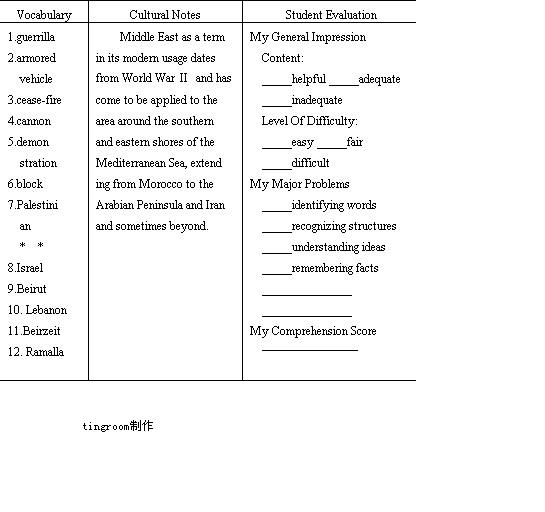
Exercises:
1.Israel____ ____its forces surrounding Palestinian guerrillas in Beirut, Lebanon.
2.More Israeli tanks and armored vehicles________ ____the area.
3.The cease-fire between the guerrillas and Israeli forces ____ ____.
4. A bomb ____Tuesday in a car outside the Palestine Research Center in west Beirut.
5.One person____ ____and at I east thirty others ____ ____.
Ⅱ.(News Item 2)
1.WHAT?__________________________
2.WHY?___________________________
3.HOW MANY? ____________________
Lesson50 Part Ⅲ An Outstanding Character ----Helen Keller( Ⅱ )
Lesson 50
Part Ⅲ An Outstanding Character
----Helen Keller(Ⅱ)
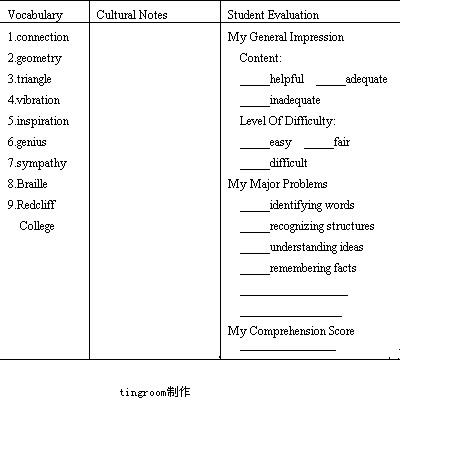
Exercises:
Ⅰ.1.What kind of teacher was Miss Ann Sullivan?
2.Was Helen eager to learn? What were some of the things she learned 7 to do? How did she learn all her life?
3.Did she finish her studies at Redcliff College?
4.What did Helen Keller think about her teacher Miss Ann Sullivan?
Ⅱ.1.Through her lectures and her writing Helen Keller reached millions of people. Her life is____ ____,not just to____ ____and____ ____but to____ ____.
2.“It was the genius of my teacher,____ ____, ____ ____which made my first years of education ____ ____.My teacher is so____ ________that I do not think of myself____ ____ ____ ____.All the best of me____ ________Everything I am today was awakened________ ____ ____ .”
- The Morse Code is made up of dots and dashes. 莫尔斯电码由点和画线组成。 来自《简明英汉词典》
- The old wolf dashes regardless into the bush. 狼发疯般不顾一切地冲进灌木林。 来自汉英文学 - 现代散文
- He carried on the business in combination with his friends.他与朋友们合伙做生意。
- The materials can be used singly or in combination.这些材料可以单独使用也可以混合用。
- The music students are learning how to score tunes for various combinations. 学音乐的学生把曲调改编为各种器乐组曲。 来自《简明英汉词典》
- Some antigens, or combinations of antigens, are much more potent than others. 某些抗原或者联合抗原可比其它抗原作用强得多。 来自辞典例句
- There are 26 letters in the English alphabet.英语字母表中有26个字母。
- The last letter of the alphabet is Z.字母表的最后一个字母是Z。
- He is a practical person.他是位很讲实际的人。
- Your invention is clever,but not practical.你的发明很巧,但不实用。