听播客学英语 08 在雨中唱歌
时间:2019-02-08 作者:英语课 分类:听播客学英语
英语课
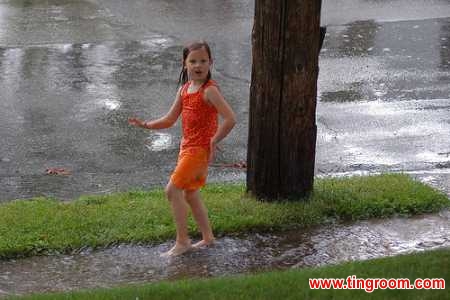
This young lady is singing in the rain, and dancing in the rain, and splashing 1 in the puddles 2 in the rain.
If you are as old as I am, you probably remember a Hollywood film called Singing in the Rain. That was Gene 3 Kelly singing a song from that film. In the film he was indeed ‘singing in the rain’, and ‘dancing in the rain’ as well, and fooling around with an umbrella in the rain. Of course, you probably noticed that he says ‘singin’ in the rain’ instead of ‘singing in the rain’. That is the way that many Americans, and quite a lot of English people too, pronounce words that end in “-ing”.
And this podcast is about words which end in “-ing”. Your English teacher may have a special name, like “gerund”, for these words. But I am just going to call them “-ing” words. You can make an “-ing” word by adding the letters ING to the end of any English verb – any verb at all, no exceptions. OK, sometimes you have to change the spelling a bit, because as you know we English love to make spelling difficult. But the sound is the same – “ing” (or “in’” if you are Gene Kelly). Go on – make a few “-ing” words now, while I am talking – yes, “talking”, that’s an “-ing” word, so are running, jumping, standing 4, sleeping, reading, eating…..and so on.
So now we have some “-ing” words, what can we do with them? The exciting answer to this question is that we can do almost anything with an “-ing” word. We can use it as an adjective, for example. If we see a child who is asleep, we can call her “a sleeping child”. If we see a baby who is crying, we can call it a “crying baby”. If we see a car that is going too fast, we can call it a “speeding car”. And if you want to swim, you go to a “swimming pool”.
We can also use our “-ing” word as a noun. We can say, for example, “I like reading”, or “I think that spelling is very difficult”. “Reading” is a noun; it is the name of the thing that I do when I read a book or a newspaper. But “-ing” words are not ordinary nouns. They never forget that they were once verbs. What do I mean by that? Well, think about these sentences. “I like reading” and “I read books”. We can combine these sentences like this – “I like reading books”. So, can you see that “reading” is a bit like a verb? Just like the verb “read”, you can put the word “books” after it, to say what you like reading. We can also say “I like reading books slowly”; we can add the word “slowly” to explain how we read.
The third way we can use our “-ing” words is to make continuous verbs. Continuous verbs are very special to English. I do not know of another language which has them, but please put a comment on the website if you think that I am wrong. We use continuous verbs when we want to explain that something is happening right now! If I say “I swim”, what does that mean? It means I can swim, perhaps I go to the swimming pool every day. But if I say “I am swimming” it means that I swim now, as I am talking to you. Think about a child in a swimming pool, learning to swim. He shouts to his mother, who is standing at the side of the pool, “Look Mum. I’m swimming. I haven’t got my feet on the bottom. I am really swimming!” And when Gene Kelly sings that he is singing in the rain, he does not mean that he sometimes sings when it rains, he means that he is singing now, and that the rain is falling now and he is getting wet now, but he doesn’t care, because he is in love or something. We use continuous verbs a lot in English, especially in spoken English. It is a good idea to practice using continuous verbs, and learning when we use them, and when we don’t!
There is a quiz on the Listen to English website where you can have fun with “-ing” words. Read through the podcast and find all the “-ing” words that I have used. See how many different ways you can find of using “-ing” words. Keep listening to these podcasts, and keep learning English.
v.使(液体)溅起( splash的现在分词 );(指液体)溅落;击水声
- Water was splashing down from a large hole in the roof. 雨水从房顶上的一个大洞里倾泻下来。 来自《简明英汉词典》
- The children love splashing water over each other. 儿童喜欢互相泼水。 来自《简明英汉词典》
n.水坑, (尤指道路上的)雨水坑( puddle的名词复数 )
- The puddles had coalesced into a small stream. 地面上水洼子里的水汇流成了一条小溪。
- The road was filled with puddles from the rain. 雨后路面到处是一坑坑的积水。 来自《简明英汉词典》
n.遗传因子,基因
- A single gene may have many effects.单一基因可能具有很多种效应。
- The targeting of gene therapy has been paid close attention.其中基因治疗的靶向性是值得密切关注的问题之一。
标签:
英语播客